Cities are starting to think about how the design of their buildings and neighborhoods could help keep them cooler.
Published previously on
Fast Company | Design
by: Nate Berg
Before it was even completed in 2014, the 38-story office tower at 20 Fenchurch Street in London made an unexpected impact on the city.
Known as the Walkie-Talkie for its distinctive handset shape, the building’s front facade gradually curves outward as it rises, making one broad side a funhouse mirror of glass. On a sunny day in September 2013, this concave surface reflected a beam of sunlight so intensely that it melted dashboards and warped the side panels of cars parked on the street below. Another day, temperature sensors recorded heat from the beam at up to 230 degrees Fahrenheit. The architect, Rafael Viñoly, conceded at the time that the problem should have been foreseen, but also suggested that some of the blame should fall on climate change bringing sunnier days to London. The developers of the building were forced to drape it with a temporary covering until a permanent sunshade could be installed nearly a year later.
But melting a few cars was only the start. Long after the so-called death ray was tamed, a different kind of complaint emerged. People walking on the sidewalk began to notice that the area in front of the building’s curved facade was much windier than the streets around it. Pedestrians reported being knocked down. Signs from neighboring buildings blew away. A restaurant delivery truck nearly toppled over. Again, the building’s distinctive shape was at fault: its forward-leaning upper floors were catching the wind and sending it down the concave facade to the street level, creating what’s referred to as a downdraft effect.
The building essentially generated its own wind tunnel, an outcome most architects and city building regulations seek to avoid. It was enough to cause the Walkie Talkie to be named the United Kingdom’s worst building of the year by Building Design magazine. The car-melting facade was addressed, but there wasn’t much to be done about the shape of a 38-story office tower. So, in addition to new office space, the building has added a windy microclimate to the city of London.

With the way things are going, that may not necessarily be a bad thing. Extreme urban heat is becoming a dangerous norm in cities around the world and the scale of the problem calls for more action. A 2022 report from the Intergovernmental Panel on Climate Change finds that up to three-quarters of the world’s population will be exposed to life-threatening heat or humidity by the end of this century. An estimated 1.6 billion city residents will face extreme heat conditions by 2050.
And this exposure has already proven deadly. A 2021 study in the Lancet found that extreme heat is the leading cause of deaths from climate-driven hazards, resulting in 365,000 deaths in 2019. It’s a number that’s almost certainly gone up. In 2023 Phoenix had a record 54 days with temperatures reaching above 110 degrees Fahrenheit. This June, more than 1,300 heat-related deaths were reported at the Hajj pilgrimage in Saudi Arabia. Around the same time, more than 5 billion people were exposed to extreme heat conditions worldwide, a stat many experts expect to get worse. “I don’t understand how people are not making it priority number one,” says United Nations chief heat officer Eleni Myrivili.
Wind offers a solution. As cities get hotter, architects and designers are exploring ways a building, or even an entire urban district, can be designed to create windy conditions on purpose. It could change the shape of cities, and redefine what makes a livable place in a hotter future.
A breeze for a hot city
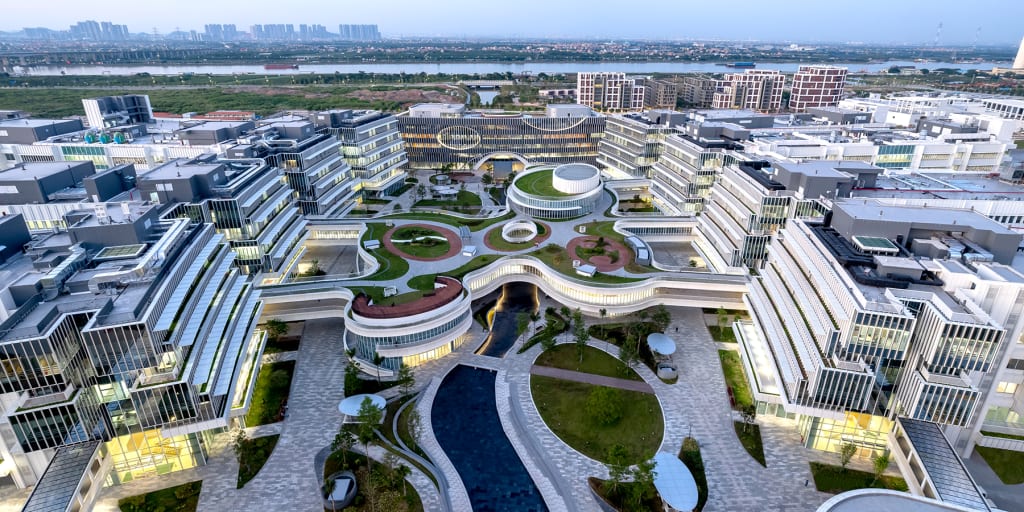
Wind is a primary goal and design parameter for the new campus of the Hong Kong University of Science and Technology in Guangzhou, China. Designed by the global architecture firm Kohn Pedersen Fox (KPF), the multi-phase, 11 million square foot campus aims to use wind to its advantage. Located in China’s muggy Pearl River Delta, where air conditioning has become a mainstay of modern development, the science-focused campus is trying to become a model for sustainable and resilient design. To reduce reliance on air conditioning, the designers have turned to natural cooling at a district-wide scale.
The campus’s first completed phase is a flower-shaped arrangement of buildings fanning out around a central courtyard that’s interwoven with walkways and canals. The orientation and form of the buildings has been optimized through a software KPF co-developed with SimScale to analyze how they’d affect wind flows and thermal conditions. Using a mix of computational fluid dynamics modeling and artificial intelligence, the software can simulate how a slight adjustment to a building’s curvature or location can optimize the flow the prevailing winds. The designers found that slicing small openings in and between buildings allowed more air to flow into the central courtyard, providing more than 40% of the space with optimal average wind speeds of about five miles per hour. It’s like a controlled version of the wind tunnel accidentally created by the Walkie Talkie building.
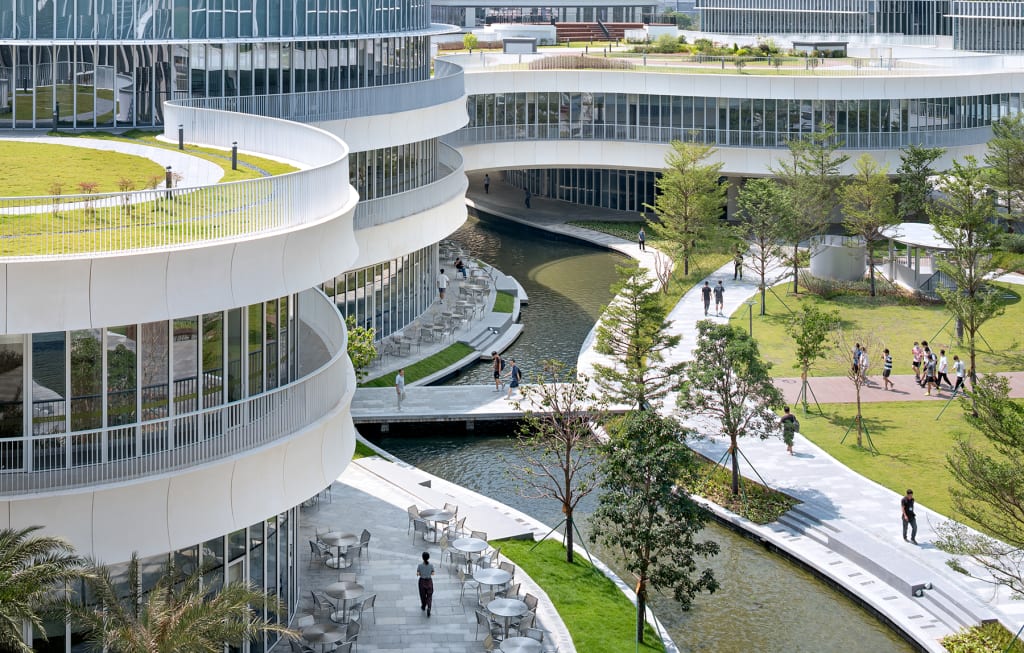
Wind tunnels are important in that you can actively create higher wind speeds in places where there otherwise woul;d not be any breeze, says Carlos Cerezo Davila, KPF’s sustainable design director. “In this project, we’re looking at every district of the campus and running every wind direction, understanding which corridors are working, which corridors are not, and how do we create openings in the buildings and change the height of the buildings so we make sure that wind is getting through.”
The result is a porous campus with wide open breaches in the architecture that, when the wind is up, makes the spaces within it much more pleasant. From Central America to the Middle East to Asia, projects around the world are embracing a similar approach, using layouts and building shapes that actively encourage wind to flow in and through their spaces.
It’s the kind of thinking more urban areas need, according to the U.N.’s Myrivili. She’s charged with helping cities around the planet understand the risks that extreme heat poses, and implement resiliency measures to avoid the worst impacts. Solutions range from planting trees to daylighting rivers to increasing shade structures, but only some cities are taking adequate steps, and making the necessary investments, to counter the growing risk of extreme heat. “I keep getting requests from city officials that are worried, asking what can we do? But still, I don’t have a feeling that people are putting their money where their mouths are,” Myrivili says.
She argues that passive cooling techniques, including building designs that channel wind, could be a way to achieve some of these resiliency goals without requiring major capital investments. In Inglewood, California, for example, the design firm AECOM used wind design to influence the roof of the new Intuit Dome NBA basketball arena, which uses specifically placed vents to pull in prevailing winds off the Pacific Ocean. Harnessing wind isn’t yet as widespread as other measures to combat heat, but Myrivili says it should become part of the toolkit of strategies cities use.
KPF’s Cerezo says designers are starting to use this approach more often, and getting more opportunities from clients and cities that see the benefit of designing with wind in mind. Given the scale of the problem, he’s hopeful this is just the start. “Up until maybe a couple of years ago, when people thought climate change, they thought flooding,” says Cerezo. “If you’re on the coast, sure, you should be worried about sea level rise. But everywhere else, heat is a problem. Everywhere else.”
Why wind design can make a difference
For all its unreliability and varying intensity, wind is a natural cooling force that has been ignored too long. Most urban wind tunnels were created by accident or happenstance. Given what we now know about controlling and even creating wind, it’s surprising that wind hasn’t become more of a part of the way cities are designed.
“To be honest, it’s old physics,” says Anthony Brower, associate principal and Americas head of sustainability at the design and architecture firm Populous. “It’s not a new idea.”
The phenomenon was first formally observed 1797 by the physicist Giovanni Battista Venturi, who saw that fluids, both liquids and gases, gain velocity when flowing through a chokepoint. Jab a spigot at the bottom of a barrel and the wine inside will rush out with force. Put a doorway at the end of a long tunnel and the wind will come bursting through. This simple consequence, known as the Venturi effect, sits at the heart of an entire branch of science called fluid thermodynamics. “There’s no upper limit to it. So you can do it with a straw, or you can do it with a collection of buildings,” says Brower.
At the urban scale, cities and architects have known this for decades. Major developments are required to perform wind studies and prevent the risk of their buildings causing such intense winds, and regulations exist in cities around the world to ensure that new buildings don’t end up creating blustery wind tunnels. Architects typically want to design buildings that won’t cause windy conditions.
But if they can be designed in with precision, windy conditions could be beneficial to human health and to the environment. Increasingly powerful computational fluid dynamics modeling systems have made it possible to apply the Venturi effect with greater certainty and control. Some of the bigger architecture firms are beginning to run these high level and time-consuming analyses as a matter of course. That’s important not because a gust of wind will magically make a hot city like Phoenix or Mecca more temperate, but because it will make the human experience of being in the extreme heat there more tolerable and less deadly.

Stefano Schiavon is one of the top experts globally on using air movement to cool people. As a professor of architecture and civil and environmental engineering at UC Berkeley he studies the biological mechanisms human bodies use to release internal heat, and the ways that indoor and outdoor environments can be made more thermally comfortable. One of the main challenges to that comfort is sweat. “And people do not like that,” he says.
Schiavon has led a series of studies that use simulations, lab experiments, and real world tests to show that the flow of air, even in very hot conditions, can make people feel more comfortable. He’s even developed free software for thermal calculations that translates the amount of wind movement to the amount of cooling it can provide. “If we increase air movement, even if you are sweating a lot, it never accumulates on your body in moderate conditions, and therefore you are feeling fine,” he says. “We call this the cooling effect of air movement.”
This has a wide range of implications. In indoor settings, adding modest air flow from fans or natural ventilation can lead to lower air conditioning and energy use for the same level of thermal comfort. At the urban scale, Schiavon’s work makes the argument that wind should be allowed and encouraged to flow through buildings and into city centers. “Because if you design your building to allow that but then the building next to you blocks it, you’ve lost that resource,” he says.
Where the wind should blow
While heat-prone places exist all over the world that could benefit from an extra breeze, those poised to benefit the most from wind design are the humid tropics and the hot and dry Middle East.
“It works best in a cooling-dominated climate, where you’ve got more hot days than cold days,” says Brower, who, until recently, was global director of climate action and sustainability for the design and architecture firm Gensler. While there, he worked on a plan for a large urban project at an undisclosed location in Central America. The 200-acre project will create a dense campus from scratch, built around a grid of streets. Given the heat and humidity of the tropical location, Brower says the client was very focused on ensuring outdoor comfort. In the early stages of the design, that looked like a lot of buildings packed closely together to minimize the amount of time people would have to spend outdoors. “I’m like, well, let’s think about it a little bit differently,” he says.
He and his team proposed altering the layout of the project’s streets to orient buildings away from the sun during the hottest part of the day, and to align with streets that can bring in the prevailing winds from the southwest and west. Computational model demonstrated that a moderate amount of wind could be brought into the open spaces of the campus simply by shifting how the buildings line up. Brower says the clients were immediately on board with the idea. “They were excited about it because it just added a layer of story,” he says. “I think what they also kind of loved about it, just like every client, is this isn’t going to cost us anything. They’re brand new streets. You have to put them somewhere.”
The concept also has relevance even outside the most extremely hot parts of the world. One project trying to harness the wind is located in Toronto. Designed by KPF, it’s a cluster of towers situated around a central plaza. KPF sustainable design director Carlos Cerezo Davila says wind studies have literally reshaped the plan. It started as a semi-circle of buildings that modeling showed would create a kind of mini wind vortex inside the plaza. Cerezo advised a few changes to the overall orientation and form of the buildings. Rotating two of the buildings reduced turbulent winds rushing between them, and stepping up the roofs of nearby buildings helped cut down on a hard downdraft that was pouring wind into the plaza. “Sometimes it’s just the designers need to change their design a little bit,” Cerezo says. “Maybe it’s more than they would like to, but sometimes the changes are not massive, and you can actually control what’s happening around the building.”
The biggest potential for harnessing the wind may be at the even larger scale of the city. Singapore is showing how designing for wind can be part of a successful strategy for using architecture and urban design for an emerging form of passive climate control.
In 2017, a coalition of university research programs and government entities in Singapore created Cooling Singapore, a set of research programs and guidelines aimed at helping the city-state address its urban heat challenges. Among the recommendations that have become policy there are guidelines for the design of buildings, including creating breezeways at the lower levels of tall buildings and using the layouts and shapes of new developments to create canyons or corridors for wind to travel along. It’s not uncommon for the first five or six floors of a residential tower to be basically open air passageways, with green and common areas for residents but also wide open spaces for wind to pass through, allowing cool air from the outskirts to make its way into the city center. “They talk a lot about geomorphology there,” says Myrivili, the UN’s chief heat officer. “They’re using design elements to actually change the way that stagnant air starts moving around.”
At the scale of a neighborhood or city, these kinds of interventions can make a big difference in hot cities, according to Schiavon, the thermal comfort expert, who has worked on research projects in Singapore for more than a decade. “When we think about wind to cool people, what really matters is where people are,” he says. “At the street level, if you stop it and you don’t have wind then you really don’t have a way to release that heat.”
Uncertain forecasts
The overarching caveat to a wind-centric approach to design is that we just don’t know for certain where the wind will blow, or whether it will blow at all. Designing a big physical building or urban district to bring wind in from specific directions runs the risk of contorting the built world around a natural resource that may never bother to show up. And in hot cities, where designing for wind is increasingly seen as a way to counter the extreme heat being exacerbated by climate change, the changing climate itself is making it harder to know whether a wind-based design will even work.
“We’re getting to this point where we can no longer depend on past weather and past climate and past conditions,” says Brower. “During summer 10 years from now, the wind could be coming in a completely different direction, and then that city layout is kind of lost.”
But as computational fluid dynamics modeling becomes more sophisticated, some of these uncertainties may be easier to plan around. KPF’s Cerezo says the software his firm has co-developed to run these analyses is dramatically faster and more useful than what was previously available. An analysis that would have taken 12 hours just a few years ago can now be completed in 30 minutes. That allows his team to apply wind analyses to more projects, within reason. “Bear in mind that we are, like, 600-and-something architects and I’m on a team of five people,” he says. “We have to be strategic with our resources.”

Cerezo is optimistic that this type of design will become even more possible, and more accurate, as the science of fluid thermodynamics continues to evolve. “We are using these modeling tools, but we know there are big uncertainties,” he says. “It’s interesting that now you have architects talking to air scientists for answers. Because we want answers.”
In the face of extreme heat, the sense of urgency is rising. Myrivili says the threat and challenge of heat in cities calls for all kinds of potential solutions, even ones like wind design that may be only just starting to be attempted at larger scales. “This is expertise that we really need for designing cities and we don’t have enough,” she says.
Nate Berg is a staff writer at Fast Company, where he writes about design, architecture, urban development, and industrial design. He has written for publications including the New York Times, the Los Angeles Times, the Atlantic, Wired, the Guardian, Dwell, Wallpaper, and Curbed. He has reported on the ground in 11 U.S. states and nine countries, and is a two-time finalist for the Livingston Awards for Young Journalists. His articles have covered a range of topics, from the evolution of Japan’s prefabricated housing industry to radical changes in the design of car headlights to preventing the loss of community gardens in London by building bat habitats. Nate started writing about urban planning and development in 2006, and in 2011 he became the first staff writer at The Atlantic Cities, now known as CityLab. After several years as a freelancer based in Los Angeles and then Berlin, he joined Fast Company in 2020. He now lives in Detroit.
 anthony brower