by: Anna Highfield
Published previously on
Architects Journal | Climate Change
With scientists predicting a 30 per cent increase in ‘uncomfortably hot’ days in the UK, Anna Highfield looks at how masterplanners are changing their design approach to reduce overheating in cities
Published last week, part one of the AJ’s three-part mini-series explored how architects can mitigate overheating in building design. Now, in part two, we explore how masterplanning can effect change on a city-wide scale.
On a building-by-building basis, architecture practices are tooling themselves up to do what they can to adapt their designs for a UK climate with significantly more ‘uncomfortably hot’ days.
But careful masterplanning is also needed if we are to create sustainable, cooler environments on a nationwide scale.
According to Ed Baker, a masterplanner for global architecture and urban design practice Broadway Malyan, UK cities are ‘not particularly well prepared’ for either our cold winters or our increasingly hot summers.
Baker says a starting point is the need for good data-modeling for any masterplan that aims to mitigate extreme temperatures. He cites Singapore – where he worked for over a decade – as an excellent example. As of 2023, the city-state has a ‘digital twin’ which can be used to analyse urban flooding and overheating risks, and assess the impact of different mitigating interventions within localised microclimates, thanks to extensive mapping and ‘open data’ gathered from its citizens with the aim of optimising the city’s infrastructure.
Baker says a similar model might not be possible in the UK as our data governance differs vastly from that of Singapore, but he insists local authorities ‘should have the capacity to be able to set up [similar] models’.
In the UK at least, Arup is ahead of the curve. The company’s tool, UHeat, combines satellite imagery and open source climate data to analyse huge areas of cities.
The engineering giant used the technology to create its recent report, Urban Heat Snapshot, comparing the urban heat island ‘hot spots’ of six major cities including London. The report identified the Kilburn and South Hampstead area as London’s most extreme ‘hot spot’, experiencing extremes 7°C hotter than nearby Regent’s Park.
Armed with data of this kind, Baker says overheating solutions must be approached in ‘scales’, starting with large-scale strategic planning and working all the way down to ‘local scale’ mitigation in individual neighbourhoods and districts.
Most experts agree the cooling benefits of urban greening and planned shading, or canopy cover, are among the most effective wide-scale interventions. The added vegetation can increase the amount of evaporation in an area, creating a cooling effect of as much as 4.43°C.
A sophisticated example of this urban greening is White Arkitekter’s major research study for the city of Stockholm, which highlighted the need for ‘smart streets’ in the city. These reduce concrete through greening and tree planting, and prioritise pedestrians and cyclists.
Similar approaches are already underway in Leeds’ Climate Innovation District, where White Arkitekter urban-designed car use out of the area; in Barking’s Gascoigne Estate, where they masterplanned tree-lined streets, permeable surfaces, and green parks and courtyards; and in Croydon’s Purley Way, which We Made That designed to be ‘driven by a detailed understanding of micro-climates’.
Another solution is ‘cool roofs’, advocated by Arup in its June 2023 ‘roofs designed to cool’ report for the Greater London Authority. Arup sets out how ‘cool’ roofs, painted with reflective white paint or fitted with solar photovoltaic (PV) panels, could be rolled out in the riskiest areas of a city like London, where there is the most heat exposure and vulnerability to heat stress, to protect houses by reflecting or absorbing the sun’s heat.
Better yet, insists Anthony Brower, sustainability and global climate action director at Gensler in LA, are green, ‘rewilded’ roofs fitted with vegetation-filled ‘planters’. Brower says these roofs need four to six feet of soil – which can be a challenging dead load for a retrofit.

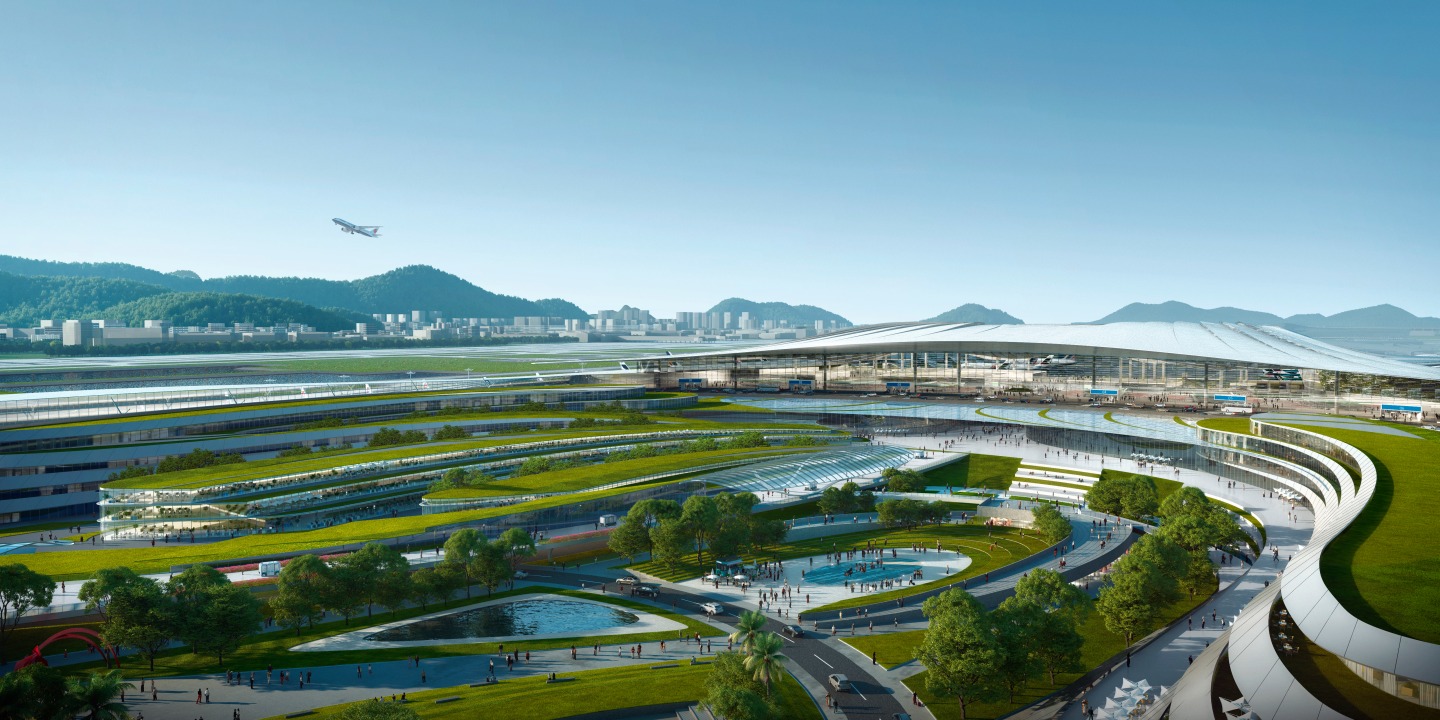
Large-scale green-roofing design for Shenzhen Airport T4 by Gensler
But by absorbing the sun’s heat energy for plant growth, they avoid the negative side effect of light-painted surfaces reflecting it and ‘double-baking the air’, which ‘raises the [overall] ambient temperature in the region’.
Brower says while ‘small and tactical’ in scale, green-roofing would create a ‘cascading benefit’ when applied to hundreds of buildings, cleaning as well as cooling the air. He says: ‘That’s the really big one that scales to the city’.
But the heat expert has a number of other suggestions at his fingertips. These include controlling the geometry of new buildings with a surface area-volume ratio ‘planning tool’ (‘I’m not advocating for spherical buildings, but as you move from rectangle to square to octagon to round and circle, your conditioned space to the enclosing envelope gets vastly more efficient’); introducing ‘umbrella’ buildings with an overhanging roof to shade their glazing and footprint; and ‘façade reprogramming’ – taking a traditional central core and ‘latching’ it on to the southern façade, thus reducing south-facing glazing and the associated overheating risk.

An ‘umbrella building’: Gensler’s Rayonier Headquarters in Florida by Polk Stanley Wilcox Architects
So is the UK’s growing overheating problem down to a lack of action rather than a lack of ideas?
Countries on the continent are already way ahead of us. In Brussels, a comprehensive research initiative by Vlaamse Instelling voor Technologisch Onderzoek (VITO) for Bruxelles Environment has mapped areas most affected by urban heat islands (UHI) to guide strategic mitigation efforts.
It concluded the focus needed to be on creating greener streets with leafy trees and ‘blue infrastructure’ (ponds and watercourses), implemented at a large scale as part of a network of ‘green corridors’ through the city. Brussels already safeguards its existing ‘urban cool islands’, including woodlands and parks.
Meanwhile, Sweden’s Environmental Administration has commissioned the Geographical Information Bureau (GIB) to make heat maps of Stockholm between 2013 and 2021 to analyse the link between greenery, the built environment, heat, and vulnerable citizens’ access to cool areas.
White Arkitekter helped develop the sustainability strategy for the city’s Royal Seaport, a mixed-use development in the north of the city, planned meticulously to provide stormwater management and shade provision and promote biodiversity.
As for the UK, Brower has some counterintuitive advice for architects and masterplanners. ‘The most impactful thing you can do,’ he says, ’is not [just] to design better on projects [but] get connected with your local community, get together with policymakers, and give them the information they need and the support they need to write stronger [planning] codes.’
The third part of this mini-series explores the UK building regs and planning codes that deal with overheating, and how they should adapt.
 anthony brower